Showing posts with label care. Show all posts

Water is Life and Irrigation is Key


Water is life: regular watering from rainfall or irrigation systems is necessary for most of the beautiful plants in your landscape design.  Unfortunately, many Florida homeowners have unknowingly spent as much as half of their utility bill on watering lawns and landscaping, when watering wisely can be so much easier than you may realize. 

All plants need to be watered during the first weeks after planting or transplanting, and during development.  Then they fall into different categories according to water needs, from the very thirsty to the drought tolerant.  In irrigation terms, efficiency refers to how much of the water applied to the plants is finally used by them and uniformity refers to how evenly the water is applied to the plants.  This is the science we employ to keep your landscaping looking its best.

A knowledgeable landscape designer will divide your plantings and irrigation segments into watering zones (hydro-zones): oasis, transitional, and xeric. The oasis zone is for the thirstiest plants and will be placed closest to a water source. The xeric zone is for plants that need no supplemental water after being established. The transitional zone will contain plants that need occasional watering, or regular watering during a drought.

It is concepts such as the three watering zones that explain why a professional landscape design will look better and thrive unequivocally through the dramatic seasons of Florida.  Your comprehensive site plan will include placement of water sources among the plantings, and you will be able to recognize the oasis, transitional, and xeric zones if you look closely.   Perhaps it is your preference to feature one of the three hydro-zones predominantly in your landscaping and we can do just that.  

A licensed landscaper, who is foremost an irrigation professional, knows the science behind a lush and waterwise landscape.  We make it our business to understand unique concepts such as field capacity, which refers to the maximum amount of water a soil may hold before draining to become runoff.  An irrigation controller is an automatic timing device that operates irrigation zones for a predetermined time and frequency.  Scheduling of irrigation is based on factors such as soil type, root zone depth, and weather conditions - it should be regularly calibrated and checked for proper functionality.

North Florida wavers between extreme drought conditions and record rainfalls.  


A Look at Homeowner Landscape Design Data Reports


The new research reported by the 2017 U.S. Houzz Landscape Trends Study was on target for our industry and we would like to present some highlights here.  

The results of the research survey come from approximately 1000 American homeowners who have completed outdoor projects in the last year, who are currently in the middle of a landscaping project, or who plan to do it soon.  These landscape designs are upgrades or updates of the current homeowner's exterior spaces, with the typical goal to make the space their own.

How much do people spend? The majority of the respondents (23 percent) spent between $1000-$5000.  Complete overhauls or major luxury landscaping were not a rare occurrence: 15 percent of the projects were over $50,000 in budget. Bottom line: Spending money on improving landscaping is considered worth the expense.

Where are the landscape projects? We know that landscaping is known to increase curb appeal exponentially, yet 69 percent of the landscaping jobs were completed in the backyard of the home.  44 percent were the front yard, and 32 percent were side yards. (Keep in mind some projects were in multiple locations.) Bottom line: We care the most about our living and entertaining spaces.

What needs are being addressed with landscaping? The number one issues that landscape design and installation were focused on were "drainage" and/or "poor use of space".  This was followed by "lack of privacy".  If curb appeal were the main goal of the landscaping work, the most important feature was flower beds/borders by a wide margin. Bottom line: Landscaping equals functionality.

How long does the project take?  It is important to remember that unforeseen problems such as extreme weather (especially in Florida) can upset project schedules. But these were the averages for three different levels of landscaping work:

Minor project: 3 months of planning/3 months of implementation
Major project: 5 months of planning/4 months of implementation
Complete overhaul: 6 months of planning/6 months of implementation

What plants are the most popular? For the past several years of studying these statistics, the top answer to this question is "low-maintenance", followed by "flowering". (Pictured at top is the stunning camellia variety, "Pink Perfection", which grows well in North Florida landscape designs.) Bottom line: Combine color with waterwise hardiness.

Ultimately, 73 percent of landscape projects are completed by a professional landscaper such as GreenFlex Landscaping.  Although, of those homeowners who are currently in the planning stage of their landscape job, only 63 percent plan to hire a professional.  

Flower of June: Passionate about Passionflower


What is the vine with the exotic purple flowers that pops up in the North Florida area in the summer months? It is no other than the stunning plant Passiflora, also called passionflower or maypop. Passiflora incarnata is the most common species in the southeast but you will most likely encounter other examples of this plant, with varieties in the many hundreds.

Passionflower when used in landscape design looks best in natural and informal plantings, as its vines tend to go where they please and are typically deciduous as opposed to evergreen. It is especially valued in butterfly gardens, as it is the food plant of many different types of Florida caterpillars. Passionflower is a fast growing perennial that can grow as high at 12 feet!

The unique purple flowers of passionflower are about three inches in diameter and each blossom only lasts 24 hours.  Our local passionflower vines, considered a wildflower, have hardy roots through very cold weather and their fruits are edible, although so popular with wildlife you will rarely get a chance to see them ripen to the orange color they attain in the late summer and fall before they are eaten.  

Passionflower is the food of a number of butterfly species, including the zebra longwing and Gulf fritillary. Bumblebees are known to become intoxicated from the nectar of passionflower (look closely at the photo at the top), and will stay on the blooms all day long, sometimes falling to the ground in a stupor.

The fruit was a favorite of colonial settlers of the South and Native Americans alike; the Cherokee called it "ocoee" and some people still know it as wild apricot.  To this day eating passionfruit is a favorite of Cajuns: they call the plant liane de grenade, or "pomegranate vine".

Native Americans taught European colonists to utilize leaves of passionflower to make a calming medicinal tea, and it is still used this way in some Central and South American cultures. There are studies currently being done to investigate whether passionflower leaf extract is a better alternative to anxiety medications than the current pharmaceutical treatment.

And finally - why is this lovely flower named for "passion"?  The label refers to the passion of Jesus in Christian history: in the 15th and 16th centuries, Spanish missionaries chose the physical structures of this flower, especially the numbers of its various parts, as symbols of their faith.  You may notice the passionflower sometimes appearing as a decorative element in Christian artworks over the centuries since.

Passionflower will always be found in areas with lots of available sunlight, never in shady areas beneath a forest canopy. Other species you could likely encounter in North and Central Florida include the Passiflora racemosa, a large evergreen vine with long clusters of bright red passionflowers, about five inches each in diameter. Also growing in gardens and forests of Palm Coast, St. Augustine, and Ormond Beach is the blue passionflower, Passiflora caerulea.

🦚Article by Connie Helena, author of The Green Orchid ðŸ¦š

Flower of May: Love for Gardenia is No Secret

We know that deep red roses are for True Love; bright yellow roses are for Friendship.  The symbolism of a flower is often a testament to its character, but not in the case of the elegant and stunning gardenia, which is the floral symbol for Secret Love.

This evergreen flowering shrub has just begun its fragrant show of blossoms this month in North Florida landscape designs.  That being said, gardenia is not salt tolerant so we would not advise you to incorporate it into beach landscaping.

Also sometimes growing in the fashion of a small tree or a hedge, gardenia have very shiny dark green leaves and its flowers are a pure white that eventually fade to yellow as they end their brilliance.  With its heavenly scent and a classic shape, gardenia are often used in weddings.

Botanists know that gardenia will continuously bloom for several months of late spring into mid summer.  Selective about its conditions and placement, gardenia does best with a professional landscaper's guidance in regards to installation and maintenance.

Gardenia is part of the coffee family of plant species, Rubiaceae, and the most common gardenia is Gardenia jasminoides, found growing wild in Vietnam, Southern China, Taiwan, Japan, Myanmar, and India. Gardenia is native to the tropical and subtropical regions of the world and has been in cultivation in China for at least a thousand years.

You may hear gardenia sometimes called "cape jasmine" or "cape jessamine".  The flowers eventually become oval fruits, and these are still used in Chinese medicine.  Gardenia is also used to make yellow dye in Asia.  It is a flower with a rich history and a popularity all over the world, either as a landscape design element or as a houseplant.

🦚Article by Connie Helena, author of The Green Orchid ðŸ¦š


Managing a Landscape to Look its Absolute Best


What can you expect when a landscaper maintains your commercial or residential landscaping?  Here is a general idea of the elements of good landscape management by a professional, experienced company:

1) Shrubs will be pruned and trimmed approximately six times per year.  We will use proper horticultural techniques so that the integrity of the plant is maintained.

2) Any dead, diseased parts of plants will be removed as well as any plant material obstructing walkways or roadways.  Clippings and cuttings will be removed from the site.

3) Small trees (up to 10 feet in height) will be trimmed and shaped to their optimal condition approximately six times per year and checked for proper growth.

4) Medium trees (10-16 feet in height) will be trimmed to maintain clear trunks from ground to lower branches, giving them a clean look and healthy growing condition.

5) If necessary, chemical treatment will be used on plants with infestations of pests or disease.  This will be done very carefully and paying attention to whether the chemicals are working.

6) Thorough weeding will occur, especially in open areas of plant beds.  The soil in these beds will be tested once per year to evaluate pH and nutrient content.

7) Fertilization of shrubs and ground cover will be done twice a year, typically in Spring and Fall.  The fertilizer used will be based on soil testing evaluations.

8) Trees will be fertilized based on size using a balanced formula, and though usually done once a year the initial application will usually be in the spring.

🦚Article by Connie Helena, author of The Green Orchid ðŸ¦š

What It Means to Manage a Landscape


A landscaper is a company that not just designs and installs landscaping for residential and commercial properties, but one that goes beyond just maintenance to management of the landscape design.  They follow strict guidelines so you can have peace of mind:

Mowing

Mowing frequency is customized based on the different growth rates of the seasons.  Certain grasses will be mowed more than others: for example, St. Augustine turf will be cut up to 44 times per year and Bahia turf will be cut up to 21 times per year.

Rotary mowers will be used and the blades will be kept sharp and maintained so grass is not torn.  Height of grass will be determined for optimal health of lawn.

Mowing patterns will ensure an even distribution of clippings for appearance and protection, and clippings will remain on turf to restore nutrients for a healthy lawn.

Edging and Trimming

Plant beds, curbs, roadways, driveways, trees, and buildings will be neatly edged and trimmed to maintain a desirable shape.

After edging and trimming, walkways and patios will be cleared to maintain a clean, well-groomed appearance.

Edging and trimming will coincide with mowing and areas inaccessible to mowers will be maintained with other equipment.

All debris created by our company will be promptly removed.

Fertilization and Control of Weeds, Insects, and Disease

Various percentages of nitrogen, phosphorus, and potassium will be determined based on different seasons and environmental conditions.  St. Augustine turf will be fertilized four times per year.

Soil tests will be performed once per year to evaluate pH and nutrient content.

It is the sole responsibility of our company to treat for insects, disease, or weeds.

All state and federal regulations will be strictly followed when applying pesticide or herbicide products.  These treatments will be performed by trained technicians only.

🦚Article by Connie Helena, author of The Green Orchid ðŸ¦š


Hurricane Preparedness Includes Your Landscaping


Hurricane season is right around the corner, and this year it begins June 1st.  This week is National Hurricane Preparedness Week and we have several tips to get your landscaping and the area around your home ready in case of major storm.  Keep in mind that you can contact a landscaper regarding hurricane readiness and safety of your landscaping, and services cover many of the suggestions below.

1) Make sure if you have a shed, greenhouse, or other outbuildings that the doors and windows are secure and will not detach in heavy winds.

2) Prune your trees so that large branches are not hanging over your home or car, and away from power lines.  Do not engage in the inappropriately named "hurricane cut", which removes most of the fronds and can severely damage, or even kill, your trees.  Instead trees should be pruned to provide for air flow, which inhibits uprooting.  If a tree is obviously unhealthy and therefore weak, it should be removed.

3) Consider planting trees that are more likely to withstand heavy winds in the first place.  Native growing trees such as the live oak in Florida are standing all these years because they are strong, hard, resistant to winds, and their roots grow deep.

4) Clear your gutters and downspouts and ensure they are firmly attached and that your drainage system is fully functioning.

5) Be ready to stake tall plants in case of a storm, and if a storm is on its way you should be ready to harvest vegetables or flowers beforehand as those fragile plantings will most likely be damaged anyway.

6) Take inventory of all your lawn ornaments, outdoor furniture, potted plants, grills, flags, awnings, and other loose items around the home.  These can become flying projectiles in strong winds and should be stored when a storm is imminent.

7) Consider replacing your gravel beds with softer wood mulch.  Small stones can be hazardous if they become airborne in extreme weather conditions.

8) If you live close to the beach and the possibility of flooding is high, keep in mind that salt tolerant plants and trees are most likely going to be the few survivors of a major storm. When saltwater creeps up higher than usual on the coastline and blows its spray through the air, salt tolerance is severely tested.

Stay safe!  Hurricane season ends November 30th.

🦚Article by Connie Helena, author of The Green Orchid ðŸ¦š


Mulch is a Must in Landscaping


One component of landscaping installation you can be assured will not be ignored by a professional landscaper is the necessity of mulch, initially applied and continuously maintained, for your garden beds.  Mulch is the material, usually organic, that covers the soil around your plants.  In nature, mulch is created by leaves and other decomposing matter and it is part of what encourages the growth of plants in both wild and structured landscape plans.

The basic purposes of mulch are to conserve moisture, improve the soil, discourage weed growth, and enhance visual harmony and beauty.  The next time you notice a property with an especially attractive landscape design, look a little bit closer and you will see how important the use of mulch is when it comes to an appealing flow to the design.  And of course, any thriving and healthy landscape will have proper mulching to thank for it.  There are even brightly dyed mulches that add a dose of color to entice the eye.    

Different mulch affects the soil in different ways and a professional landscaping company will be familiar with the prime choices of mulch for your particular landscape design.  Bark chips, shredded mulch, wood chips, and wood chip mulch are some examples of what may be used locally and these materials vary in appearance, cost, availability, and effect on the soil underneath.  Rocks, crushed stone, and gravel are also considered a material for the process of mulching, with its own special accommodations.

Mulch is applied as deep as six inches to keep soil temperature and moisture at a stable level.  Application of mulch decreases evaporation so plants get properly watered, and blocks sunlight so that weeds cannot sprout.  Mulch slowly decomposes into the soil, which is why it needs to be replaced periodically. 


How will you design your landscaping?


You have your property and you know you need a new landscape design planned, installed, and ultimately maintained.  There are options available to you when beginning this project - a project that can be so significant that it basically creates the very first impression everyone who visits your home will experience.  Consider these starting points:

1) Design it yourself.  This is an acceptable idea if you are by trade a professional landscape designer.  If not, you will need more understanding of your property's soil, climate, and weather patterns than you probably realize.  You will also need to know the growth schedule and needs of the plants you use for your landscaping so that you can create a year round design.  Watering and pest control are important components of successful landscape design in Florida, so you should be well versed in these factors as well.

2) Utilize feng shui concepts.  Perhaps this Chinese method of decorating will be a good guide to how your landscape should be set up and designed.  Feng shui takes into consideration directional placement, color meanings, use of water features and lighting, the flow of "energy" through the garden, and the elements of wood, fire, water, earth, and metal.  Feng shui is not for everyone, but it may be the way you want to design your landscape, although it leaves out important maintenance considerations.    

3) Duplicate other landscape designs.  There is such an abundance of material to peruse when designing your landscaping.  Magazines, web sites, books, and other sources will give you a wealth of ideas when you are collecting your personal landscape inspiration.  Perhaps you will decide to copy some plant and design choices found in your own geographic area, taking into consideration how well this works for the local climate.  Keep in mind: soil, sun, and watering can be very different for each particular property and you may have very little idea of how much regular maintenance is required.  

4) Hire a professional landscaper.  Most successful landscape designs either begin with a professional designer or continue indefinitely with one.  This is because with an established, licensed company, you know that you are hiring someone who knows the conditions and climate of your property better than most and will create beautiful gardens that reflect this knowledge.  Landscapers have not just the initial design to think about, but the long term performance of the plants and trees that are selected for each unique project.  Another benefit of utilizing the services of a professional landscaper is that you can also incorporate your own design ideas, whether they come from feng shui or other sources, and work together in harmony to create something amazing and personal!

🦚Article by Connie Helena, author of The Green Orchid ðŸ¦š 


Palm Coast Landscape Blog Highlights


This landscape blog covering Palm Coast, Flagler Beach, Ormond, Daytona, and St. Augustine is in its third year of knowledge sharing for those readers interested in Florida landscaping issues.  Here are the top five posts of all time, counting our total readership well into the thousands:

1) Century Plant and Agave in the Florida Landscape Design - Still one of the most stunning examples of our unique northeast Florida botanical elements for landscaping, this plant is as fascinating as it is beautiful.

2) Amazing Facts About the Live Oak Tree - This tree is nothing if not majestic and apparently many web searches seeking information on the live oak bring web visitors to this post.

3) The everlasting green beauty of Florida landscape design - The second blog ever posted, announcing important company news and sharing an interesting tidbit and quote about color, has stayed in the top ever since.

4) Florida Holly is Not So Festive After All - This explains in detail the truth about one of our area's most mistakenly identified trees, and even if you know its true identity, you may not know the whole story.

5) Fire Pits Add Cozy Heat to Florida Evenings - Fire pit design, as aspect of hardscaping that GreenFlex Landscaping specializes in, has gotten more popular as a functional landscape design feature.


The truth about Amaryllis flowers

In the early spring of northeast Florida we begin to see signs of what many of us call the Amaryllis flower - a tall spike of large showy flowers emanating from a bulb in the ground.  In cooler parts of the country these bulbs are grown in pots indoors and are sold around the holidays.  Our climate enables us to put these beauties in our landscaping and enjoy their return each year, as well as their thriving propagation.

What may surprise you is that this flower is not an Amaryllis at all, but rather a Hippeastrum, according to botanists who have been divided on the issue for centuries!  A true Amaryllis is a South African bulb related to the Hippeastrum, a flower which originates in South America.  The decision was made official in 1987 but that has not changed the common (incorrect) classification.

Other facts of note regarding the Hippeastrum:

1) It includes about 90 species and 600 plus hybrids and cultivars.
2) Some Hippeastrum have evergreen leaves and some deciduous (seasonal).
3) This flower usually has six petals, three on the outside and three inside.
4) Depending on the species, there may be two or as many as 15 flowers on one stem.
5) Some varieties of Hippeastrum are air plants, which is why the bulbs need exposure to air.
6) The plants can be food sources for butterfly and moth larva.
7) Hippeastrum is Greek for "knight's star", most likely a reference to the morning star weapon.
8) These bulbs do not respond well to frost or too much watering.
9) The first commercial growers of Hippeastrum were the 18th Century Dutch.
10) There are five types of flowers: single, double, miniature, cybister, and trumpet.

🦚Article by Connie Helena, author of The Green Orchid ðŸ¦š

Accent Lighting for Your Florida Landscaping


Landscape lighting will provide glowing accents that make your home or establishment equally as captivating once the sun goes down.  This type of lighting is decorative but can also be functional: lighting pathways and driveways for safety while walking or driving, or to provide added security around the perimeter of the property.

If you are putting your home on the market for sale, keep in mind that most interested buyers will be driving by the property before ever contacting your agent.  And many of them will be doing so after work, when it may have already gotten dark.  Professionally designed, well maintained landscaping is proven to increase curb appeal so make sure it is evident at night as well.

Accent lighting throughout the landscape will be lovely to look at from your windows, from your pool, or from your outdoor lounging and entertaining areas.  We think you will find the benefits of incorporating this nocturnal art form will be an investment that pays off for years to come.

Looking for inspiration for landscape lighting styles?  Check out these articles on Houzz.com or explore your options by searching "landscape lighting" on HGTV.com.

🦚Article by Connie Helena, author of The Green Orchid ðŸ¦š


Get inspired by hardscaping design


Brick is classic, stone is elegant, pavers are modern...no matter your preferred style of hardscaping, the most important fact to remember is that well maintained hardscapes are inviting and contribute major curb appeal to your property. If gravel areas are bare in patches, pavers are cracked, or weeds have crept into spots they should not have, then you might be wise to hire a professional landscaper to remedy the situation.  Start with hardscaping upgrades:  the result will be a beautiful design and the impression of a home that is immaculately maintained.

Looking for ideas?  What moves you?  It is always advisable to choose what you like and let your landscaping company know ahead of time.  Here are some places to start:

Do a "hardscaping" search on Pinterest.

Take a gander at Pinterest boards such as Landscape Inspiration - you will notice that the most popular landscape designs pretty much always involve some type of hardscaping.

Read and enjoy these amazing, photo-rich articles on Houzz that pertain to hardscape design.

🦚Article by Connie Helena, author of The Green Orchid ðŸ¦š


Here's the Scoop on St. Augustine Lawn Maintenance


In this blog post we are going to cover one of the most commonly seen varieties of grass used in Florida lawns, St. Augustine, also known as Carpet, Wire, Buffalo, or Charleston grass.  St. Augustine is used primarily in tropical and subtropical areas and usually requires a sprinkler system.  Because St. Augustine turf is very thick and dense, it crowds out weeds and other unwanted grasses.  It has a lovely dark green uniform color year round as long as its maintenance needs are fully met.

Fun facts about St. Augustine grass include:

  • It has been used for lawns in Florida since the 1890s.
  • It is native to the Gulf of Mexico and Mediterranean regions.
  • It has a high level of salt tolerance for beach landscaping. 
  • A new variety was developed in 2008 that is resistant to chinch bugs.
  • It grows only in coastal regions.
  • Propagation is by plug, sod, or stolon - seed propagation was only recently made possible.

The best way to describe a St. Augustine lawn is that it is like a carpet in its thickness, spreading and growing its runners of grass so that nothing else can penetrate it.  This species of grass performs well in many soil conditions with consistent fertilization and attention to its moisture needs.  We will not only install and maintain your St. Augustine lawn, but we also understand the watering necessary to maintain it.

Alternatively, if you would prefer a softer lawn that is similar to the ones found in Northern climates or on golf courses, you may want to learn more about zoysia grass

Zoysia Grass for Soft, Fine Florida Lawns


Did you think lush, soft lawns in Florida were only to be found at golf courses?  Or even worse, did you think you had to give up a fine textured lawn when you moved to the sunny, warm Florida climate? Fortunately more and more of our customers are discovering the beauty of zoysia grass, a variety of turf that was introduced in the United States in 1900 from Korea.  

Zoysia is often seen used on golf courses where a dense, low-cut turf is desired.  It does go dormant in winter though, so you cannot expect a full year of bright green grass as you can with St. Augustine lawns.  But if St. Augustine grass seems too rough and heavy to you, consider zoysia.  It requires about the same level of care and watering but you can walk barefoot in zoysia and it feels lovely.  

Once established, zoysia holds its own against weeds and other grasses. When watering, the rules are consistent: water in early morning and water deeply, wetting the soil to a depth of 4 to 6 inches. Generally zoysia does not have many insect, disease, or thatch problems if properly maintained.  

Well Maintained Landscaping for Safety and Curb Appeal


Thinking about trimming those palm trees yourself?  Keep in mind, the Consumer Product Safety Commission recommends that unless you have the professional skill and experience to do so, you should not perform household tasks that require you to climb anything higher than a six foot ladder.  Reportedly, ladder injuries have become a major factor in emergency room visits.

There are so many reasons why you should consider the services of a landscaper to maintain the grounds of your home or business.  Did you know that untrimmed bushes and shrubs could give coverage to a burglar attempting to break in through your doors or windows?  Or that one of the things that thieves look for is a home with a lawn that has not been mowed, indicating that the homeowner is on an extended absence?  

In a previous Florida Landscape Design post, we went over the ways that professional landscaping design and care will raise property values in areas such as St. Augustine, Palm Coast, and Ormond Beach, where motivated sellers are looking for ways to give their houses added curb appeal.  There are other facts to consider when making the choice to trust your lawn and landscape's maintenance to a company such as GreenFlex Landscaping:
  • Studies have shown: 75 percent of interested buyers drive by an available property and 63 percent look at photos online before walking through. You simply must have the exterior appearance at peak perfection.
  • Outdoor landscape lighting gives your property curb appeal at night!  This is becoming evidently more important as so many potential home buyers drive by homes for sale during the evening hours, after work. 
  • It is recommended that to look its absolute best, a home must have its lawn mowed twice a week in the summer.  Along with that it is necessary to pull weeds from beds and sweep or blow walkways clear of trimmings and debris. 
🦚Article by Connie Helena, author of The Green Orchid ðŸ¦š


Landscaping for Ormond Beach, Palm Coast, and Saint Augustine


New residents to northeast Florida find almost immediately that landscaping here is very different than other parts of the country.  There are specific varieties of plant material that thrive in this area, many of which require specific care for optimal health.

Landscape designing and installation in the Palm Coast, Ormond Beach, and St. Augustine areas is challenging and many people find it beneficial to outsource these tasks to professional companies.  Choosing a trusted company to install and maintain your landscaping and lawn is of the utmost importance - check that your landscaping service provider has the appropriate licensing, customer testimonials, and insurance.

Florida living is close to nature and the outdoors; it is usually an active lifestyle of beach, golf, and swimming.  Palm Coast landscaping companies are full service landscape design, maintenance, and installation organizations.  As your Florida landscape designer, we will create an outdoor space that invites entertaining and enjoyment with water features, hardscaping design, outdoor lighting, and a green lawn.

Ready to take your landscaping to the highest level of style, beauty, and growth?  Do you need consulting on the best plants and trees for your particular landscaping project?  Is your existing lawn not up to par? 

Florida Holly is Not So Festive After All

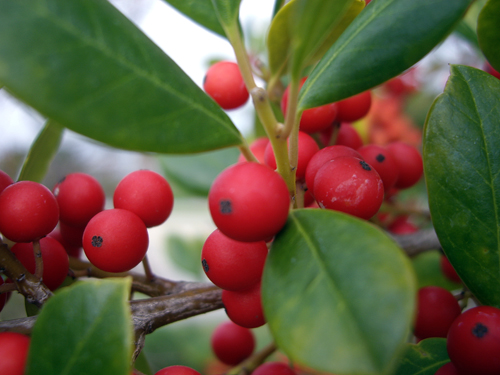
In northeast Florida as we celebrate the holidays we may enjoy the presence of "Florida Holly" trees in our yard producing red berries to enhance the season. Think again: these trees are actually a highly invasive species better known as the Brazilian-pepper tree!

Schinus terebinthifolius is also mistaken for the innocent sounding "Christmasberry" tree, but this plant is responsible for allergic skin reactions and respiratory illness (when blooming), not to mention that over 700,000 acres in Florida are covered by this weed making these areas inhospitable to native plants and wildlife.

The Brazilian-pepper tree is actually native to Brazil, Paraguay, and northern Argentina and was introduced to Florida in the 1800s to be cultivated and sold as an ornamental plant. Why does it enjoy Florida and the rest of agricultural zones 9-11 so much? Its salt tolerance is high, it will grow in any soil, has no nutritional requirements, grows very quickly, has high drought tolerance, and loves full sun.

Not at all related to holly but rather to poison ivy, this trickster has the potential to create a dense forest canopy that shades out all other foliage and produces such a poor habitat for native wildlife species that almost nothing other than the Brazilian-pepper itself will survive. It is highly prohibited to plant Brazilian-pepper tree or encourage its growth.

On an interesting note, this plant is grown for culinary purposes in other countries and marketed as "pink peppercorns" here by itself or in spice blends. Bees love the flowers of Brazilian-pepper and make honey from its nectar. Raccoons and possums eat the fruit of the plant and contribute to its spread by passing the seeds, as do seed loving birds such as the migratory American Robin. It is believed that some birds and other wildlife adore the berries of this plant for their narcotic effects at certain times of the year.

If you have "Florida Holly" in your yard, you can use its fruit-laden branches as Christmas decorations because the small bright red berries will mature between December and January. From a professional standpoint, it is never acceptable for a landscape designer to encourage these invasive species for landscaping in Ormond Beach, St. Augustine, or Palm Coast.

🦚Article by Connie Helena, author of The Green Orchid ðŸ¦š


Century Plant and Agave in the Florida Landscape Design

Newcomers to northeast Florida are often captivated by the site of the gigantic century plants thriving so impressively in landscape designs from St. Augustine to Ormond Beach. Also known as maguey or American aloe (although not in the aloe family), century plant (Agave americana) actually only lives to be 10-30 years. This waterwise ornamental plant has a large dramatic form when fully grown and is prized for modernist, desert-style landscape designs, as well as being perfectly suited for Florida-friendly xeriscaping.

The spreading rosette shape of century plant can grow as wide as 13 feet and its leaves can be almost seven feet long.  Each leaf tip is extremely sharp and can pierce skin, so do not plant this drought tolerant beauty anywhere near a childrens' play area!  Alternatively, century plants can be cultivated along a perimeter as a natural fence to keep people or animals in or out of a designated zone.  The two most commonly encountered Agaves are the blue straight leaved type and the variegated curly leaved species.  If you are drawn to more exotic varieties, landscapers can help you incorporate them into your landscape design for St. Augustine, Palm Coast, and Ormond Beach.    

These succulents will bloom only once, their unique flowers growing many feet in the air on stalks, and after they bloom they will die.  So enjoy this amazing plant for as long as it lives! Various Agaves are used to produce tequila, mezcal, and pulque in Mexico, as well as agave nectar, a healthy and natural alternative to sugar.  The fibers from certain century plants are also used in Mexican crafts and textiles. 

Amazing Facts About the Live Oak Tree

The majestic live oak tree (Quercus virginiana) is one of the world's most eye catching and fascinating species of tree and it is located throughout the southern United States including Sanford, Deltona, DeBary, Daytona Beach, Port Orange, Lake Helen, Orange City, DeLand, and Ormond Beach, Florida. If you have one of these incredible species in your landscape design already, you most likely have an appreciation for its visual impact as well as its maintenance challenges.

Including new live oak saplings in a landscape design is making investments for the long term: they may not look as enticing in the beginning as they most certainly will in a few decades. A Volusia or Seminole County, Florida tree service will assist you with caring for aged live oaks.  Landscape designers will discuss all the things you need to know about incorporating potentially beautiful live oaks into your design, or designing around their already established presence. Keep in mind these facts regarding this native tree:

-There are other species of live oak, but the southern live oak is the most well known and was the first to be given that name. Live oaks indicate the evergreen types of oak tree (the ones that do not lose their leaves in the fall, as opposed to deciduous).

-Live oak is a huge, sprawling tree that reaches heights of 65 feet to 85 feet at maturity and has been known to live 500 years or longer.

-Live oak is the southern symbol of strength and the state tree of Georgia.

-Live oak trees require very little watering when first planted and when it reaches four to five feet tall, supplemental watering is no longer necessary.

-Live oaks are one of the heaviest native American hardwoods, weighing 55 pounds per cubic foot when air dry. Its strong, dense wood explains why these trees have outlasted so many Florida hurricanes.

-Live oaks support many types of epiphytic (air) plants, including Spanish moss (Tillandsia usneoides) and resurrection fern (Polypodium polypodioides). These plants do not harm the tree in any way and add to its beauty.

-The large amount of acorns produced by the live oak are food for wild turkeys, wood ducks, jays (including the threatened Florida scrub jay), quails, whitetail deer, raccoons, squirrels, yellow-bellied sapsuckers, and black bears among others.

-Bulow Creek State Park in Ormond Beach is one of the largest remaining stands of southern live oak forests in Florida. Within its boundaries is the Fairchild Oak, one of the largest and oldest live oak trees in the South.